
Dedicated Internet vs. Business Broadband: Cost, SLA, and Reliability Comparison
Compare dedicated internet and business broadband by bandwidth commitments, service levels, full contract cost, support, and backup design.
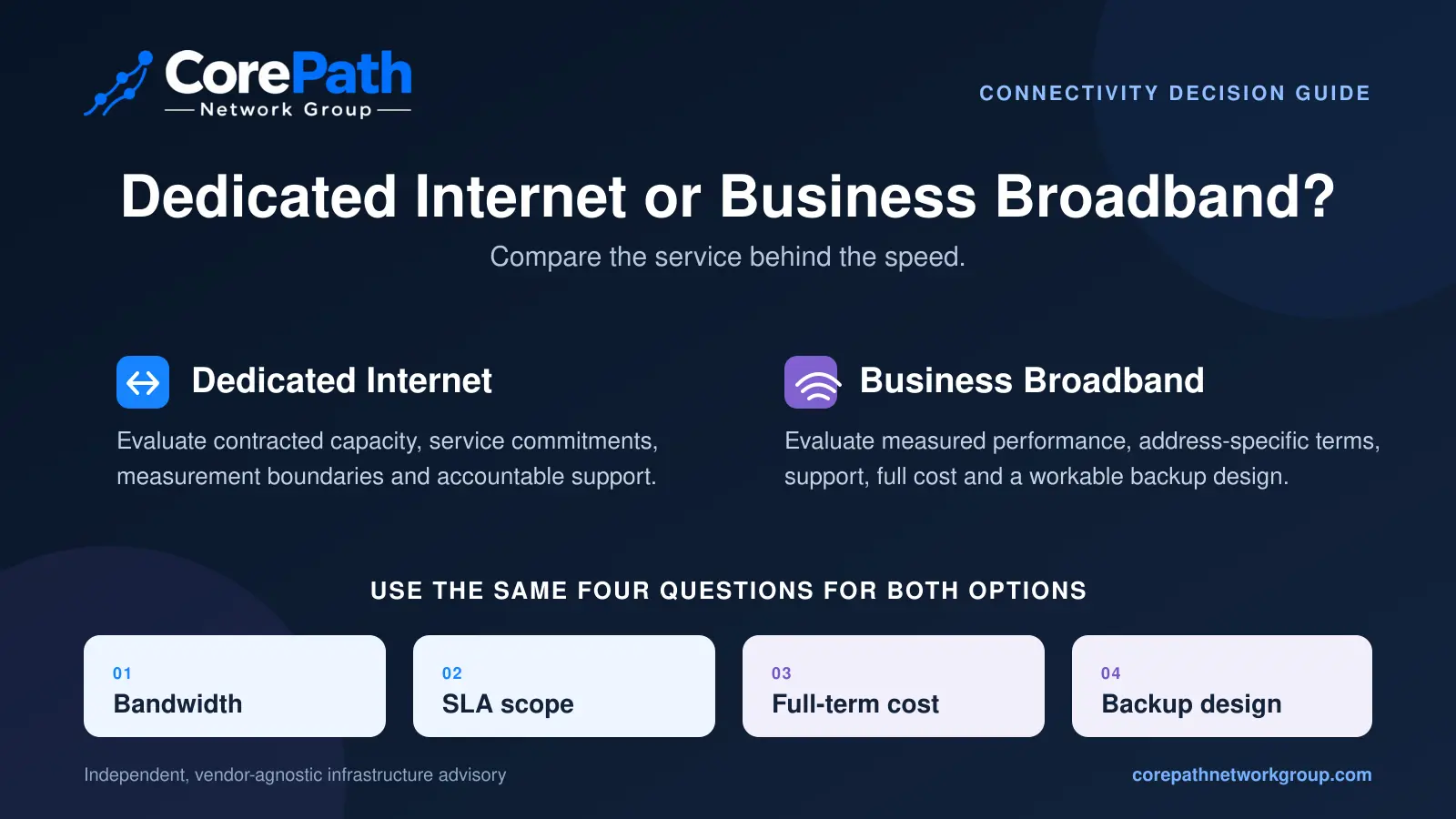
Dedicated internet deserves evaluation when a location needs contracted bandwidth, defined service commitments, and accountable support. Business broadband deserves consideration when its measured performance, commercial terms, and backup design meet the location's requirements at an acceptable full cost.
Neither the word "fiber" nor a large download number settles the comparison. A broadband connection might offer symmetrical speeds. A dedicated service might still depend on one building entrance, one router, or one local access route.
Start with the applications and the consequences of losing connectivity. Then compare the exact services available at the address, including their agreements and operating dependencies.
Internet service comparison at a glance
- Compare the contracted service, not only the advertised access speed.
- Check upload capacity, busy-period performance, latency, jitter, and packet loss against application needs.
- Read the applicable service-level agreement, including measurement boundaries, exclusions, and remedies.
- Price the entire term, including installation, equipment, support, and backup.
- Verify physical and operational dependencies before treating two connections as independent.
- Test the applications that must continue working during a failure.
What is dedicated internet access?
Dedicated internet access, often shortened to DIA, provides a dedicated access service to the provider's internet network with specified bandwidth and service commitments. Ask what capacity the provider commits to deliver, where it measures performance, and which access components the agreement covers.
For example, Comcast Business distinguishes Dedicated Internet from its shared Business Internet product and describes symmetrical bandwidth with an SLA. Those are product-specific representations, not promises covering every dedicated offer. Comcast Business Dedicated Internet
Dedicated internet is still internet access. Do not assume its service commitments cover every external network, SaaS platform, or application endpoint. Keep private connectivity, encryption, firewall controls, and other security requirements explicit in the design.
What is business broadband?
Business broadband covers business internet services delivered through technologies such as cable, shared fiber access, or fixed wireless. The access method and service package determine the actual terms. Broadband is not a synonym for residential service, slow upload speed, or the absence of all support commitments.
Comcast's Business Internet page now describes symmetrical speeds in selected areas and tiers, while stating actual speeds are not guaranteed. AT&T describes Business Fiber as a broadband access service with symmetrical speeds. These examples show why speed symmetry alone does not establish DIA. Comcast Business Internet and AT&T Business Fiber
Some business broadband offers provide outage benefits. AT&T's published support guidance lists qualifying benefits for both Business Fiber and Dedicated Internet, subject to restrictions. An outage benefit is not necessarily equivalent to a dedicated-service SLA. Obtain the agreement for the specific product and establish what commitments, if any, apply. AT&T qualifying outages
Dedicated internet vs. business broadband: the decision table
| Comparison | Dedicated internet: verify | Business broadband: verify |
|---|---|---|
| Bandwidth | Contracted capacity, any burst model, and the service measurement point | Advertised tier, actual upload/download behavior, and any guaranteed minimum |
| Symmetry | Committed upload and download rates | Whether symmetry applies to the quoted tier and address |
| Performance | Covered latency, jitter, and packet-delivery metrics | Measured application performance and any written commitments |
| Availability | Covered service elements, exclusions, and credit process | Applicable service guarantees, outage benefits, and limitations |
| Support | Monitoring, fault reporting, escalation, and restoration terms | Included support, optional management, and carrier coordination |
| Installation | Address qualification, access route, construction, and delivery dependencies | Serviceability, equipment, inside wiring, and activation requirements |
| Resilience | Backup design and shared failure points | Backup design and shared failure points |
| Commercial fit | Full-term cost, flexibility, and consequences of a service failure | Full-term cost, flexibility, and consequences of a service failure |
Use the table as a provider-response framework, not a list of universal product guarantees. Both options need technical validation and a realistic operating plan.
Compare usable bandwidth before buying a larger circuit
Collect utilization over representative business periods. Include uploads, concurrent calls and meetings, backups, large transfers, cloud applications, and planned growth. Average use alone might hide a short period when the connection becomes a constraint.
Separate the physical handoff or port speed from the bandwidth purchased under the service. Confirm whether the offer includes a fixed rate, a committed rate with additional usage, or a maximum advertised speed. Identify how the provider measures and bills any additional usage.
Also investigate the local network. Test with a suitable wired device and check firewall throughput, security inspection, Wi-Fi, cabling, and endpoint limitations. A faster access circuit will not resolve a bottleneck elsewhere in the application path.
Define an acceptance test around actual applications. Ask whether the connection supports the required upload activity while voice, collaboration, and critical transactions remain usable. For a multi-site design, our SD-WAN and dedicated fiber guide explains how traffic management and underlying connectivity fit together.
Read the SLA beyond the availability percentage
A service-level agreement defines the provider's commitments and the conditions for a remedy. It does not remove the possibility of an outage or establish that a credit covers the business's losses.
Review these questions before comparing headline percentages:
- What is measured? A backbone metric, local access circuit, managed router, and application transaction are different measurement scopes.
- Where does measurement begin and end? Ask whether an advertised latency figure covers the application destination or only specified provider network points.
- Which events qualify? Review degradation, total service loss, maintenance, customer equipment, power, third-party services, and other exclusions.
- When does the clock start? Establish ticket, testing, customer-response, and restoration rules.
- What must the customer do? Record notification and claim deadlines, required evidence, and the responsible account contact.
- What is the remedy? Compare credits, caps, recurring-failure rights, and any relevant termination provisions.
Verizon's published Internet Dedicated SLA distinguishes measurement scope and exclusions, and contains plan-specific credit eligibility. Comcast's Nitel connectivity attachment separately limits its stated SLA to dedicated services and describes credit requirements. These documents illustrate why the applicable agreement matters more than a general claim of "enterprise-grade" service. Verizon Internet Dedicated SLA and Comcast Nitel connectivity attachment
What availability percentages mean mathematically
For a hypothetical 30-day measurement period containing 43,200 minutes:
| Availability percentage | Minutes outside that percentage |
|---|---|
| 99.9% | 43.2 minutes |
| 99.99% | 4.32 minutes |
| 99.999% | 0.432 minutes, or 25.92 seconds |
This is arithmetic, not an outage forecast, allowed downtime, or a reconstruction of a provider's credit rules. Actual agreements use their own measurement periods, event definitions, exclusions, and remedies. A 100% commitment is not proof that service cannot fail.
Compare full contract cost, not only cost per Mbps
Request address-specific quotes for a common term and requirement. Avoid using a generic price range as a market benchmark. Access availability, construction, service scope, bandwidth, support, and contract structure change the comparison.
Build the commercial comparison from:
- Recurring access charges and any promotional changes or escalators.
- Installation, construction, inside wiring, and demarcation extension.
- Router, firewall, IP addressing, monitoring, and support charges.
- Backup access, equipment, power protection, and testing.
- Migration overlap and coordination with the incumbent service.
- Renewal notice periods, minimum terms, upgrade rights, and exit charges.
Keep service costs separate from a scenario-based assessment of operational disruption. Document which functions stop, what continues through backup, and what recovery requires. Do not treat speculative outage losses as proven savings from buying DIA.
Our telecom contract renewal checklist helps organize deadlines and commercial questions before requesting alternatives.
Reliability requires more than a dedicated circuit
Design to reduce shared failure points, regardless of the primary service category. Ask both providers to identify the underlying access carrier, physical route, building entry, demarcation, and any known common dependencies. Two different sales brands do not establish two independent access paths.
Review power, routers, firewalls, switching, and routing alongside carrier access. A second circuit connected through the same unprotected device leaves that device in the failure path.
Wireless backup introduces its own questions: signal quality, available capacity, traffic allowances, public addressing, and equipment power. AT&T's Business Fiber page explicitly notes that its described wireless backup does not operate during a loss of power. Validate the exact backup package instead of assuming wireless solves every failure. AT&T Business Fiber backup conditions
Test a primary-link failure with the required applications running. Check detection, traffic switching, session behavior, capacity, and return to the primary link. Assign responsibility for monitoring, escalation, and periodic testing to the internal team or contracted operator.
When does each option deserve priority?
Evaluate dedicated internet when commitments matter to the location
Prioritize a DIA comparison when the site has sustained upload demand, application performance requirements, or a need for specific bandwidth, support, and service commitments. Validate those requirements against the actual offer rather than treating DIA as an automatic answer.
Evaluate broadband when its tested service fits the requirement
Broadband belongs in the comparison when application demand, measured performance, contract terms, and a workable backup design satisfy the location's needs. A lower-cost primary service might be appropriate, but only after defining what must continue during disruption.
Evaluate a mixed design across a portfolio
A headquarters, distribution site, small office, and retail location need not use the same service category. Establish a common evaluation method, then match each site's connectivity and failover requirements to available options. Standardize operational visibility and responsibility where useful, rather than forcing identical access at every location.
Questions to send every provider
Ask each bidder to respond to the same list:
- What exact product and access technology serve this address?
- What upload and download bandwidth is contracted, and where is it measured?
- Which performance and availability commitments apply to this product and plan?
- What service boundary, exclusions, reporting rules, and credit limits apply?
- What support, monitoring, and restoration commitments are included?
- Who owns the underlying local access, and what diversity evidence is available?
- What site work, construction, customer readiness, and dependencies affect delivery?
- What equipment, power, addressing, and backup services are required?
- What are the complete charges across the proposed term?
- What renewal, modification, reduction, and termination rights apply?
For a broader evaluation process, use our vendor-agnostic infrastructure procurement guide.
Dedicated internet and broadband FAQ
Is fiber internet always dedicated?
No. Fiber describes an access medium. Business broadband also uses fiber. Confirm the purchased service, capacity commitments, and applicable terms.
Is broadband always asymmetrical or without an SLA?
Not necessarily. Symmetry and service commitments are separate product terms. Published broadband offers include symmetrical tiers and outage benefits, but a benefit is not automatically a DIA-equivalent SLA. Ask for the specific plan and agreement.
Does dedicated internet guarantee every cloud application will perform well?
No. Check the SLA's measurement boundary and test the application path. Local equipment, other networks, and the application service remain part of the end-to-end assessment.
Is one dedicated circuit better than two broadband connections?
There is no universal answer. Compare actual service requirements, capacity, shared dependencies, failover behavior, support, and cost. Neither circuit count nor product label establishes application continuity.
Does an SLA pay for lost revenue?
Do not assume so. Review the actual remedy and liability provisions. The cited carrier examples use defined service credits with conditions, rather than a general promise to reimburse business losses.
Review your connectivity and carrier options
CorePath Network Group's resilient connectivity advisory helps organizations define requirements and compare access options, providers, commercial terms, and resilience considerations without starting with a preferred carrier.
CorePath is an independent, vendor-agnostic advisory and sourcing firm. Selected carriers deliver connectivity. Internal teams and contracted technical providers operate the environment. For standard sourcing engagements, the client pays no direct advisory fee; CorePath receives compensation from the selected provider or distribution partner after deployment. The client retains final decision authority.
Explore Topics

Written by
Alex DeMott, MBA, PMP
Alex works with IT and business leaders on infrastructure strategy, provider evaluation, procurement, contract decisions, and complex technology initiatives across colocation, cloud, and connectivity.