Cloud Repatriation: When Moving Workloads Out of Public Cloud Makes Financial Sense
Compare an optimized cloud baseline with private and hybrid options, including migration costs, commitments, connectivity, and operational ownership.
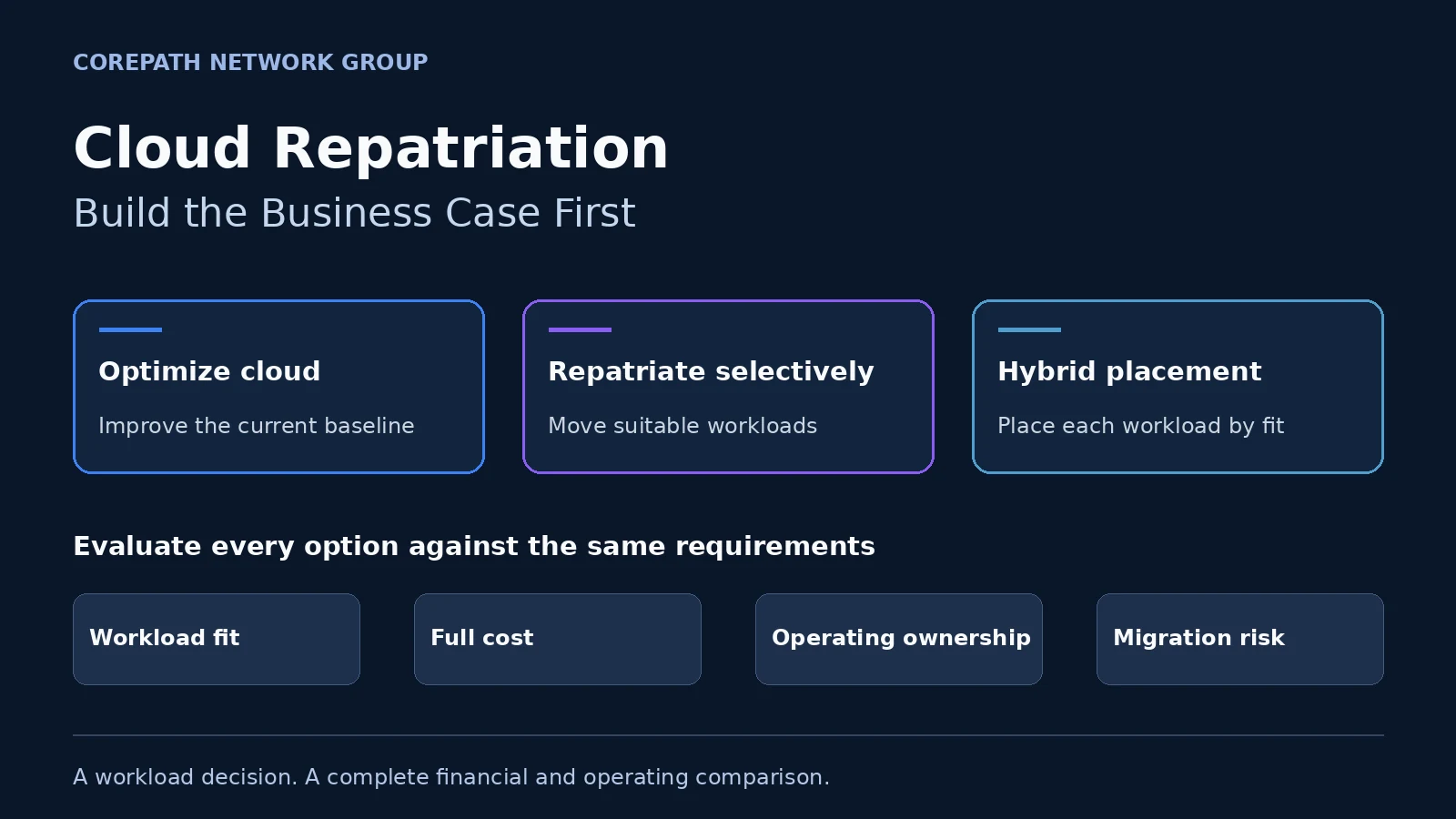
Cloud repatriation deserves consideration when a workload has predictable demand, clear portability, and a private or hybrid alternative with a lower full cost. The alternative also needs to meet the same performance, security, recovery, and operating requirements.
A rising cloud invoice alone does not establish a reason to move. First compare an optimized cloud environment with a fully priced destination. Then add migration costs, remaining commitments, and the work required to operate the replacement.
This guide helps IT and finance leaders evaluate a specific workload before approving a cloud exit, purchasing hardware, or renewing a long-term commitment.
Cloud repatriation at a glance
- Start with one workload and its business requirements.
- Compare against an optimized public-cloud baseline.
- Price the complete destination, including staffing, software, connectivity, backup, and recovery.
- Include equipment, migration, parallel operation, and remaining obligations.
- Verify exit-transfer eligibility before counting provider credits.
- Test the application, recovery process, and rollback plan before committing to a cutover.
- Choose public, private, or hybrid placement based on measured fit.
The decision is whether a different placement improves the workload's economics and operating position. A blanket cloud exit is a separate, broader decision.
What is cloud repatriation?
Cloud repatriation means moving a workload, application, or dataset from public cloud to infrastructure outside the original cloud environment. Destinations include customer-operated hardware, a private-cloud provider, or customer equipment housed in a colocation facility.
A hybrid approach moves selected components while retaining others in public cloud. For example, a team might evaluate moving a predictable processing workload while retaining cloud-based applications with different requirements.
These models assign different responsibilities. Colocation supplies contracted facility services. Operating systems, applications, hardware lifecycle, and other technical responsibilities still need an owner. A private-cloud proposal should state which operating services the provider includes.
For the broader comparison, read our public cloud, colocation, and hybrid infrastructure cost guide.
Which workloads deserve a closer look?
Use these signals to prioritize an assessment. They are screening criteria, not a guarantee of savings.
| Workload condition | Question to investigate |
|---|---|
| Consistent demand and repeatable resource usage | Does a reserved private capacity model outperform an optimized cloud configuration? |
| Large, repeated data movement | Which transfers disappear after the move, and which new transfers replace them? |
| A portable application with limited platform dependencies | What changes are needed for databases, identity, automation, monitoring, and backup? |
| A cloud commitment approaching renewal | Is renewal, partial relocation, or a shorter commitment the better choice? |
| Existing infrastructure with documented spare capacity | What incremental costs and shared costs belong to the workload? |
| A requirement for different control or data placement | Which design meets the actual requirement and produces the evidence needed? |
Document average and peak CPU, memory, storage capacity, storage performance, network throughput, and growth. Include seasonal demand and the consequences of running short of capacity.
A workload with unpredictable bursts, extensive managed-service dependencies, or demanding delivery deadlines deserves particular scrutiny before a move. Replacing cloud services also introduces engineering and operating work. Quantify the tradeoff rather than assuming purchased servers replace the complete environment.
Optimize the cloud baseline before comparing destinations
Separate two questions: whether the workload wastes resources, and whether the workload belongs in a different environment.
Review idle resources, oversized instances, storage tiers, retention, nonproduction schedules, architecture, and data-transfer paths. Validate changes against the application's performance requirements. AWS's cost-optimization guidance treats resource type, size, and quantity as workload-level decisions. AWS resource-sizing guidance
Use three scenarios:
- The current environment and current spend.
- A feasible optimized cloud environment, including the cost of implementing the changes.
- The proposed destination, including transition and ongoing costs.
Do not credit a move with savings available through a simpler cloud change. Also do not treat projected cloud optimization as achieved. Record the evidence, implementation effort, owner, and confidence behind each assumption.
FinOps Foundation's workload-placement framework calls for comparing financial viability alongside functional and availability impacts. Its success measures include benefits net of migration and support costs. FinOps workload-placement framework
Build a full-cost comparison
Choose a common evaluation period. Use a period long enough to include the proposed commitment and relevant equipment lifecycle. A three-year model is a useful starting point, but the right horizon depends on the project.
| Cost category | Optimized public cloud | Private infrastructure or colocation-backed destination |
|---|---|---|
| Compute and storage | Measured usage, selected pricing model, and growth | Equipment or contracted capacity, maintenance, and spare capacity |
| Facility and power | Included within applicable cloud service pricing | Space, power, cooling, installation, and agreed escalators |
| Software | Database, operating-system, marketplace, and application charges | License portability, subscriptions, support, and replacement tools |
| Network | Measured cloud transfer and connectivity charges | Internet, private connectivity, cross-connects, security, and redundancy |
| Operations | Internal effort and purchased support | Internal effort and explicitly contracted operating services |
| Resilience | Required backup, replication, and recovery design | Backup, second location, recovery capacity, and testing |
| Transition | Optimization or modernization work | Export, refactoring, migration, parallel operation, testing, and decommissioning |
| Remaining obligations | Existing commitments and commercial terms | Cloud obligations during the move plus destination commitments |
Keep cash spending separate from accounting treatment. Either model hardware purchases and residual value as cash flows, or use a consistent allocation method for an operating comparison. Do not count the same purchase as both upfront capital and monthly depreciation in one cash model.
For an existing facility, distinguish incremental cash costs from allocated shared costs. Spare capacity does not make labor, recovery, refresh, or future expansion free.
A worked example: lower monthly spend without a better decision
The following figures are hypothetical. They illustrate the method, not CorePath Network Group customer results or market prices.
Assume the same workload meets its requirements in all three options:
| Scenario | Monthly recurring cost | Upfront and transition cost | 36-month total |
|---|---|---|---|
| Current cloud environment | $28,000 | $0 | $1,008,000 |
| Optimized cloud environment | $23,000 | $0 | $828,000 |
| Private infrastructure alternative | $18,000 | $300,000 | $948,000 |
For this simplified example, the private option's $300,000 consists of $180,000 in equipment and $120,000 in transition costs. Transition includes migration, testing, and parallel operation. Its recurring cost includes facility, connectivity, software, operating effort, and recovery. The optimized cloud changes require no additional cash spending in this example.
The model assumes constant monthly costs, no residual hardware value, and no taxes or financing costs. A real approval model should address those items and the timing of cash flows.
Against today's cloud bill, the private option appears to save $60,000 over three years. Against the optimized cloud baseline, the same move costs $120,000 more.
Under unchanged assumptions, a $5,000 monthly difference takes 60 months to recover $300,000. A refresh, capacity expansion, or additional operating cost changes the result. The three-year decision does not support moving for cost alone.
Stress-test growth, utilization, staffing, network traffic, migration duration, and refresh timing. Ask finance to evaluate discounted cash flows where appropriate.
Check commitments before assuming the bill disappears
Inventory each commitment's amount, expiration, scope, and cancellation or transfer rules. Separate cloud-provider commitments from marketplace purchases and software contracts.
AWS Savings Plans exchange a usage commitment for lower eligible rates, with one- or three-year terms. Moving a workload does not establish an exemption from the agreement. Review remaining obligations with the account team before finalizing the model. AWS Savings Plans documentation
Document which costs disappear immediately, which fall only after a renewal, and which remain during the transition. Use the actual contract and product rules rather than a general assumption about a provider.
Verify exit-transfer credits before counting them
As of October 9, 2026, AWS, Microsoft Azure, and Google Cloud publish exit-related data-transfer programs. Their qualification rules differ. These programs do not make ordinary ongoing egress free, and they do not remove application or migration work.
| Provider | Published program conditions relevant to planning |
|---|---|
| AWS | Request approval through AWS Support. Approved moves generally have a 60-day completion window. A partial single-service move requires discussion with Support. Specialized transfer services are excluded. |
| Azure | Give Support advance notice, follow the exit process, and request an invoice credit. The general program requires cancellation of associated subscriptions. UK-specific service-exit rules differ. Specialized services are excluded. |
| Google Cloud | Submit an Exit Notice before qualifying migration. Follow the initiation, migration, and completion process. End usage of the relevant eligible service. Moving only part of a service is excluded from the exit program. |
Sources: AWS exit-transfer FAQ, Azure exit-transfer requirements, and Google Cloud exit program.
Request confirmation for the specific account, services, geography, transfer method, and timeline. Keep ordinary egress and other transition charges in the budget until eligibility and credit mechanics are clear.
Our cloud egress costs guide explains how to map data movement before changing architecture.
Validate operating responsibility and security
A replacement environment needs an explicit operating model. Compare responsibilities for hardware failures, patching, access management, encryption keys, logging, monitoring, incident response, backup, and recovery.
Cloud already involves customer responsibilities. AWS's shared-responsibility model distinguishes provider infrastructure duties from customer duties, which vary by service. Use the actual service and destination agreements to identify how those duties change. AWS shared-responsibility model
Ask the internal team, MSP, or selected technical provider to confirm:
- Who operates each layer and covers after-hours incidents?
- Which controls need rebuilding or different evidence?
- Which data-location and customer-contract requirements apply?
- Who tests recovery, and what recovery time and data-loss limits must the design meet?
- What budget covers the required skills and operating tools?
Infrastructure ownership alone does not establish compliance. Have security and relevant business stakeholders approve the destination and control evidence before migration.
Decide between staying, moving, and a hybrid design
| Direction | Evidence needed before approval |
|---|---|
| Stay and optimize | A feasible optimization plan meets requirements at an acceptable full cost. |
| Repatriate selected workloads | The destination meets the same requirements, delivers a supported business case, and has an achievable migration plan. |
| Use hybrid placement | Keeping different components in different environments improves fit after including connectivity, transfer, and operating costs. |
| Defer the move | Commitments, missing evidence, delivery dates, or operational gaps prevent a credible near-term business case. |
For a hybrid design, map every cross-environment dependency. Test latency, throughput, routing, failover, and the cost of data flowing in both directions. Moving compute while retaining a tightly coupled database deserves explicit performance testing.
If the destination involves colocation, use the data center RFP checklist to give providers one set of requirements. Review colocation pricing per kW when comparing power, facility, and commercial assumptions.
What to assemble for a cloud placement review
Collect cloud invoices and usage exports, workload and dependency inventories, average and peak utilization, data-flow volumes, software terms, remaining commitments, security requirements, and recovery targets. Include proposed destination quotes and the people responsible for operations.
The first review should produce a shortlist of workloads worth analyzing, an optimized cloud baseline, a complete destination estimate, and a list of unresolved assumptions. A defensible decision follows the evidence rather than a preferred platform.
Cloud repatriation FAQ
Is cloud repatriation always cheaper?
No. Equipment, operating effort, software, recovery, connectivity, and transition costs change the comparison. Measure against an achievable optimized cloud baseline.
Should every workload move together?
Not by default. Evaluate workloads and their dependencies. A staged or hybrid approach needs its own network, cost, and operating model.
Do cloud exit programs cover the full migration?
No. The cited programs address qualifying data-transfer charges. Their conditions and exclusions differ. Budget migration engineering, parallel operation, service usage, and outstanding commitments separately.
What should happen before cutover?
Confirm destination readiness, application performance, data validation, recovery testing, operating ownership, acceptance criteria, and rollback. Retire the old environment only after the responsible teams approve acceptance and retention requirements.
Review your cloud cost and workload placement
CorePath Network Group's cloud placement and optimization advisory helps IT and finance teams evaluate workload requirements, provider options, connectivity, commercial terms, and placement across public cloud, private infrastructure, and hybrid environments.
For standard sourcing engagements, the client pays no direct advisory fee. CorePath Network Group receives compensation from the selected provider or distribution partner after deployment. Clients retain final decision authority. Selected providers and the client's technical teams remain responsible for service delivery and ongoing operations.
Request a 20-minute cloud cost and workload-placement review.
Explore Topics
Written by
Alex DeMott, MBA, PMP
Alex works with IT and business leaders on infrastructure strategy, provider evaluation, procurement, contract decisions, and complex technology initiatives across colocation, cloud, and connectivity.